
Electricity bills for UK businesses are about to jump again. From April 2026, a 60% rise in grid transmission charges, a new nuclear levy, and the rollout of half-hourly settlement will all hit at once. We modelled the actual annual energy cost for five different kitchen setups to show exactly what operators should expect to pay.
Three Charges Hitting at Once
If you run a commercial kitchen in the UK, your electricity bill is about to change shape. Not just the total at the bottom, but the composition of what you are actually paying for. From April 2026, three separate changes are landing on business energy bills simultaneously, and none of them have anything to do with how much energy you use.
- TNUoS charges are rising by 60-64%
Transmission Network Use of System (TNUoS) charges fund the high-voltage grid that carries electricity from power stations to your local network. From April 2026, these charges are increasing by an average of 60-64% as the UK enters the RIIO-ET3 price control period. Ofgem has approved up to £80 billion of grid investment over the next five years to accommodate offshore wind and other renewables. That bill is being passed on to every electricity user in the country.
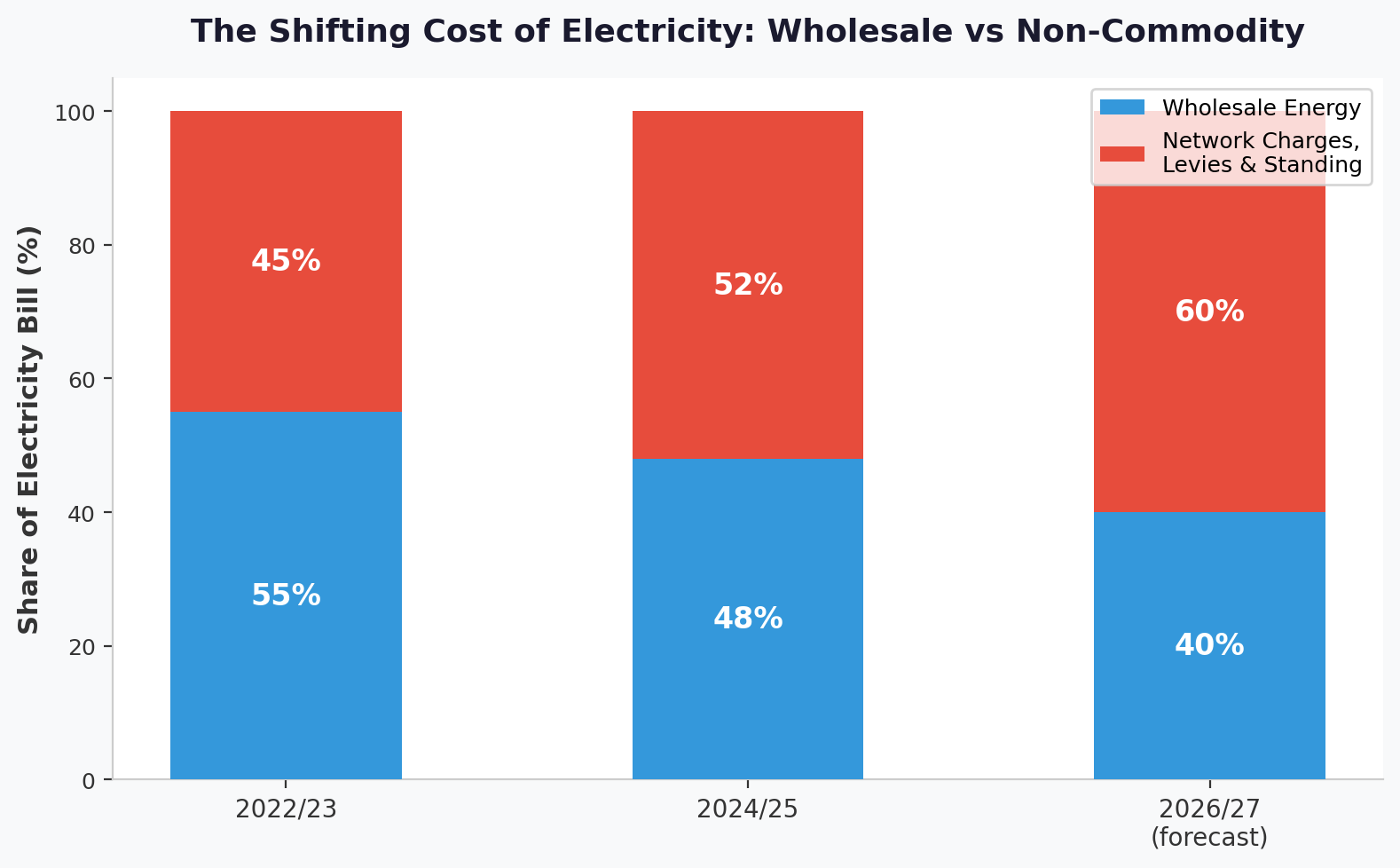
TNUoS currently makes up around 8% of a typical business electricity bill. By 2030/31, industry analysts expect that figure to reach 23%. Total TNUoS revenue is jumping from £5.1 billion in 2025/26 to £8.9 billion in 2026/27. A large chunk of this increase arrives through standing charges, which means you pay more regardless of how much electricity you actually use.
- The RAB nuclear levy is a new line on your bill
The Regulated Asset Base (RAB) charge started appearing on electricity bills in December 2025. It funds the construction of the Sizewell C nuclear power station. The rate for Q1 2026 is £3.66 per MWh (0.37p per kWh), rising to around £4.50 per MWh from April 2026. For a mid-size restaurant using 42,000 kWh a year, that adds roughly £155-£189 to the annual bill before VAT. It is a small amount individually, but it is another cost that did not exist 12 months ago.
- Half-hourly settlement changes how you are billed
Market-wide Half-Hourly Settlement (MHHS) is rolling out from May 2026 onwards. Instead of estimated usage profiles, your electricity consumption will be metered and billed in 30-minute blocks. For kitchens that run most of their heavy equipment during peak hours (typically 4pm to 7pm), this could mean higher effective rates because peak-period electricity is more expensive. Kitchens that already run equipment outside peak periods may see little change or even a small saving.
The shift: Non-commodity charges (grid fees, levies, standing charges) now make up roughly 60% of a typical business electricity bill. Even if wholesale gas prices fall, your total bill is likely to go up.
How We Built This Cost Model
We modelled the annual energy cost for five common kitchen setups using the following inputs. All figures are based on published data and industry benchmarks.
| Input | Value | Source |
| Electricity unit rate | 23p/kWh | Ofgem / energy broker mid-range for SME (April 2026) |
| Gas unit rate | 7p/kWh | Energy broker average for SME fixed contracts (March 2026) |
| Electricity standing charge | 58p/day | Mid-range of Ofgem 46-70p/day band |
| Gas standing charge | 36p/day | Mid-range of 27-45p/day band |
| Climate Change Levy (electricity) | 0.775p/kWh | HMRC CCL rates 2026/27 |
| Climate Change Levy (gas) | 0.775p/kWh | HMRC CCL rates 2026/27 |
| VAT | 20% | Standard business rate |
Consumption benchmarks were drawn from BEIS energy statistics, Dephna market data, EnergyBrokers.co.uk, and published catering industry guides. Where ranges exist, we used mid-point values. Mobile catering costs include generator fuel and LPG rather than mains gas.
Five Kitchens, Five Very Different Bills
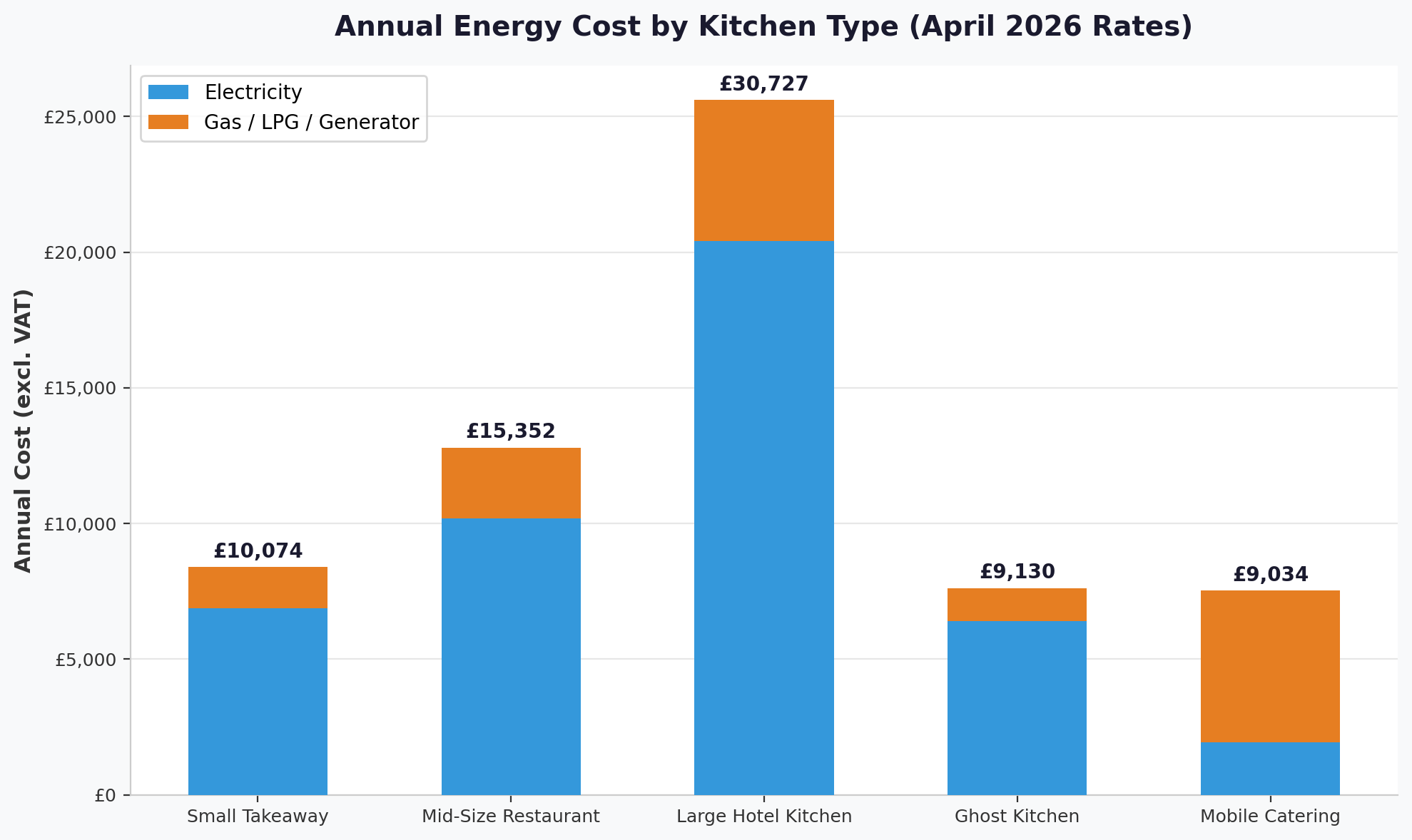
The table below shows what each kitchen type can expect to pay annually from April 2026. The figures include unit rates, standing charges, the Climate Change Levy, and VAT at 20%.
| Kitchen Type | Electricity Use | Gas Use | Electricity Cost | Gas/Fuel Cost | Total (incl. VAT) |
| Small Takeaway | 28,000 kWh | 18,000 kWh | £6,866 | £1,529 | £10,074 |
| Mid-Size Restaurant | 42,000 kWh | 32,000 kWh | £10,183 | £2,610 | £15,352 |
| Large Hotel Kitchen | 85,000 kWh | 65,000 kWh | £20,420 | £5,185 | £30,727 |
| Ghost Kitchen | 26,000 kWh | 14,000 kWh | £6,390 | £1,218 | £9,130 |
| Mobile Catering | 7,500 kWh | LPG/Gen. | £1,928 | £5,600 | £9,034 |
Small Takeaway
Fish & chip shop or kebab house, 2-3 fryers, single oven, prep fridge, chest freezer
A small takeaway uses around 28,000 kWh of electricity and 18,000 kWh of gas per year. Most of the electrical load comes from fryers and refrigeration running throughout service hours. The total annual energy bill at April 2026 rates comes to £10,074 including VAT, up from an estimated £9,199 in 2024/25. That is a 10% increase.
For a business turning over £150,000 to £250,000 a year, energy now sits at around 5-7% of revenue. Three years ago, that figure was closer to 3-4%.
The biggest savings for a small takeaway come from upgrading to energy-efficient fryers and making sure refrigeration seals are in good condition. A modern electric fryer with digital temperature control uses roughly 30% less energy than an older model running at full power all service.
Mid-Size Restaurant
40-60 covers, combi oven, range, dishwasher, walk-in fridge, extraction system
A mid-size restaurant with 40-60 covers typically uses 42,000 kWh of electricity and 32,000 kWh of gas annually. The combi oven is usually the single biggest energy draw, followed by refrigeration and the dishwasher. The total annual energy bill at April 2026 rates comes to £15,352 including VAT, up 9% from 2024/25.
Restaurants are particularly exposed to the MHHS changes because the main cooking period (4pm to 7pm for dinner service) falls squarely in the peak electricity pricing window. Operators who can shift some prep work to morning hours may see a genuine saving once half-hourly billing takes effect.
Large Hotel Kitchen
Full-service hotel kitchen, multiple combi ovens, blast chiller, multiple walk-ins, room service
A full-service hotel kitchen is the heaviest energy user on this list, consuming around 85,000 kWh of electricity and 65,000 kWh of gas per year. Multiple combi ovens, a blast chiller, walk-in cold rooms, and an extraction system running from early morning through to late evening all contribute. The annual bill at April 2026 rates comes to £30,727 including VAT.
Hotels with multiple sites face an especially sharp TNUoS impact. The standing charge element of TNUoS is applied per meter point per day. A hotel group with 20 sites will pay the increase 20 times over, regardless of how much electricity each site uses. UKHospitality has flagged this as a particular concern for multi-site operators.
Ghost Kitchen
Delivery-only kitchen, compact setup, 1-2 cooking stations, commercial fridge/freezer, no dining area
Ghost kitchens (also called dark kitchens or cloud kitchens) use around 26,000 kWh of electricity and 14,000 kWh of gas annually. With no dining area, no front-of-house lighting, and a compact layout, they are the most energy-efficient kitchen model on this list. The annual energy bill at April 2026 rates works out at £9,130 including VAT, up 10% from 2024/25.
The catch is that ghost kitchens are almost entirely delivery-based, which means the peak cooking window aligns with the evening delivery rush (5pm to 9pm). Under half-hourly settlement, operators running multiple high-powered cooking stations during that window could see a sharper effective rate increase than the headline figures suggest.
Mobile Catering
Street food unit or festival trailer, generator-powered, LPG for cooking, limited refrigeration
Mobile catering units work differently from fixed kitchens. Most use a diesel or petrol generator for electricity and LPG cylinders for cooking. Generator fuel costs typically run to £3,200 per year, with LPG adding another £2,400. Electricity consumption is lower at around 7,500 kWh, but the cost per kWh from a generator is higher than mains supply. Total annual energy costs come to around £9,034 including VAT.
Mobile operators are partly shielded from the TNUoS and RAB changes because they are not on mains electricity for most of their trading. But they are fully exposed to fuel price volatility. A 10% rise in diesel prices would add roughly £320 to annual costs.
The Year-on-Year Picture
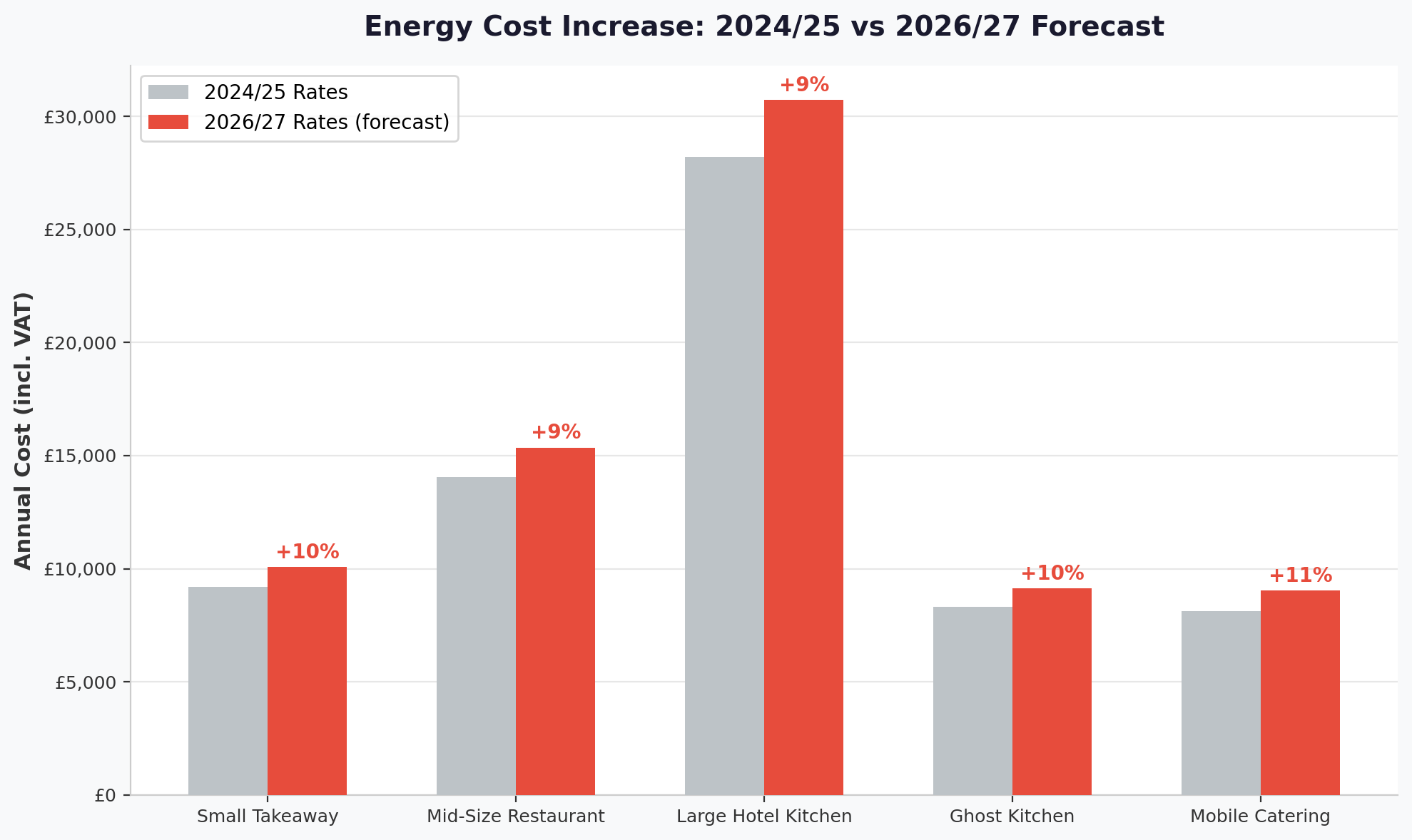
The chart below shows how energy costs have shifted between 2024/25 and 2026/27 for each kitchen type. The increase is not just about wholesale prices. The bulk of the uplift comes from non-commodity charges: TNUoS, the RAB levy, and higher standing charges.
| Kitchen Type | 2024/25 Cost | 2026/27 Cost | Increase (£) | Increase (%) |
| Small Takeaway | £9,199 | £10,074 | +£875 | +10% |
| Mid-Size Restaurant | £14,062 | £15,352 | +£1,290 | +9% |
| Large Hotel Kitchen | £28,200 | £30,727 | +£2,526 | +9% |
| Ghost Kitchen | £8,327 | £9,130 | +£803 | +10% |
| Mobile Catering | £8,134 | £9,034 | +£900 | +11% |
A mid-size restaurant paying around £14,062 in 2024/25 can expect to pay £15,352 in 2026/27. That is an extra £1,290 a year on energy alone, before any changes to how much gas or electricity the kitchen actually uses.
Where the Energy Actually Goes
Understanding which equipment costs the most to run is the first step to controlling your energy bill. In a typical mid-size restaurant, the energy split looks like this:
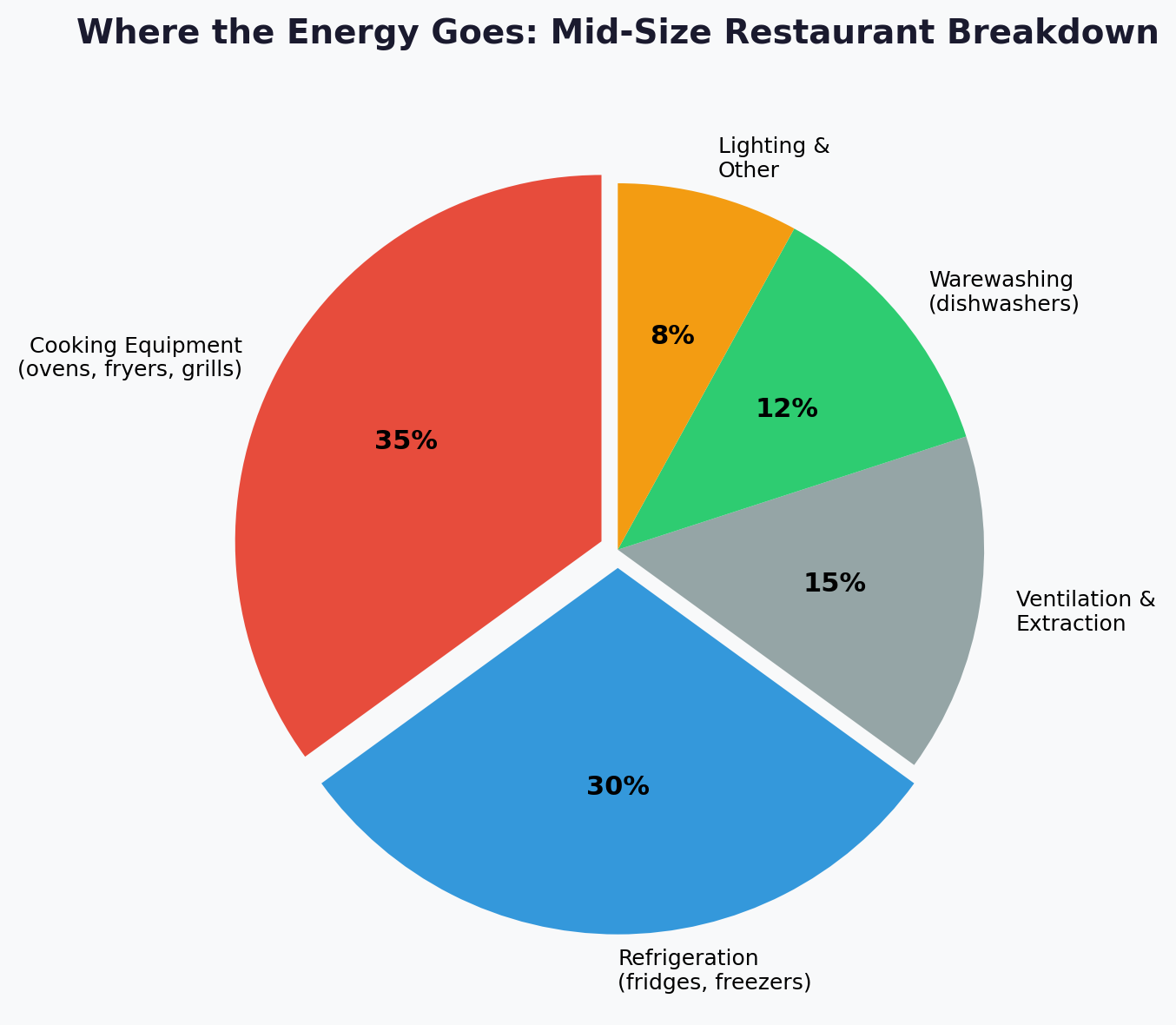
Cooking equipment (35% of energy use)
Ovens, fryers, and grills are the biggest single category. A commercial combi oven uses between 15 and 40 kWh per day depending on size and usage. A deep fat fryer left on unnecessarily throughout service can cost over £650 a year in wasted energy. Modern combi ovens with programmable settings and automatic switch-off use significantly less than older models running manually.
Refrigeration (30% of energy use)
Fridges and freezers run 24 hours a day, 365 days a year. That makes them one of the most consistent energy draws in any kitchen. A single commercial upright fridge uses around 4 to 8 kWh per day. Worn door seals, blocked condenser coils, and overstocking can increase that by 20-30%. Regular maintenance is the cheapest energy saving measure available.
Ventilation and extraction (15% of energy use)
Commercial kitchen extraction systems run throughout every service. Older systems run at full speed whether the kitchen is busy or empty. Demand-controlled ventilation adjusts fan speed based on cooking activity and can cut ventilation energy by up to 50%.
Warewashing (12% of energy use)
A commercial dishwasher running 15-20 cycles a day uses both electricity and hot water. Heat recovery dishwashers capture waste heat and reuse it to pre-warm incoming water, reducing the energy needed per cycle.
What You Can Do About It
You cannot control TNUoS charges or the nuclear levy. But the unit rate portion of your bill (the 40% you can influence) responds directly to how much energy your kitchen uses and when it uses it.
Review your equipment
Older commercial ovens, fryers, and refrigeration units can use 30-40% more energy than modern equivalents. If your combi oven is more than 8-10 years old, the running cost saving from a replacement could pay for itself within two to three years at current rates. Energy-efficient fryers with digital temperature control, rather than simple thermostat models, hold oil at the correct temperature without overshooting, which cuts both energy waste and oil degradation.
Fix the basics first
Before spending money on new equipment, check the low-cost fixes: fridge and freezer door seals, condenser coil cleaning, extraction filter maintenance, and dishwasher descaling. These cost almost nothing but can reduce energy consumption by 10-15%.
Think about timing
Once half-hourly settlement takes effect, operators who can shift some energy-intensive work (batch cooking, dishwasher cycles, blast chilling) to off-peak hours will pay less per kWh. Peak pricing typically runs from 4pm to 7pm on weekdays. If your main prep can happen before 2pm, that is money saved.
Check your contract
Many hospitality businesses are still on out-of-contract or deemed rates, which can be significantly higher than negotiated tariffs. With wholesale prices currently lower than their 2022-2023 peak, locking in a fixed-rate deal before the April TNUoS increase lands could save several hundred pounds a year. Some energy brokers specialise in the hospitality sector.
Consider B-Grade when replacing equipment
If an old fryer or oven needs replacing, the upfront cost of a new energy-efficient model does not have to be full retail price. B-Grade commercial kitchen equipment is brand-new, carries full warranties, and typically costs 30-50% less than standard retail. The energy savings from a modern unit combined with the lower purchase price makes the payback period even shorter.
Frequently Asked Questions
How much electricity does a commercial kitchen use per year?
It depends on the type and size of the operation. A small takeaway typically uses 24,000-36,000 kWh of electricity per year. A mid-size restaurant uses 30,000-50,000 kWh. A large hotel kitchen can use 60,000-100,000 kWh. These figures come from BEIS energy statistics and published catering industry benchmarks.
What is the average energy bill for a UK restaurant in 2026?
At April 2026 rates, a mid-size restaurant (40-60 covers) can expect to pay around £15,352 per year on combined electricity and gas, including VAT at 20%. This covers unit rates, standing charges, and the Climate Change Levy. Actual bills will vary based on location, contract type, equipment age, and operating hours.
How much does it cost to run a commercial fryer per hour?
A typical electric commercial fryer draws between 3 and 6 kW. At 23p per kWh, that works out at 69p to £1.38 per hour in electricity alone. Over a 10-hour service day, a single fryer costs £6.90 to £13.80 to run. A deep fat fryer left on unnecessarily can add over £650 per year to your energy bill.
What are TNUoS charges and how do they affect businesses?
TNUoS (Transmission Network Use of System) charges pay for the high-voltage electricity grid. From April 2026, these charges are rising by 60-64% due to £80 billion of planned grid investment under Ofgem’s RIIO-ET3 framework. A large portion is charged through daily standing charges, so businesses pay more regardless of consumption. TNUoS is expected to grow from 8% to 23% of a typical business electricity bill by 2030/31.
Are ghost kitchens cheaper to run than restaurants?
Yes, for energy at least. Our model shows a ghost kitchen costs around £9,130 per year in energy, compared to £15,352 for a mid-size restaurant. The saving comes from no dining area lighting, no front-of-house heating, and a more compact cooking setup. But ghost kitchens have other costs that offset this, including delivery platform commissions of 25-35%.
How much energy does a combi oven use?
A commercial combi oven uses between 15 and 40 kWh per day depending on size, model, and how heavily it is used. At 23p per kWh, that is £3.45 to £9.20 per day, or £1,240 to £3,310 per year. Modern combi ovens with programmable controls and energy-saving modes use significantly less than older manual models.
What is the RAB charge on electricity bills?
The RAB (Regulated Asset Base) charge is a new levy on all UK electricity bills that funds the construction of the Sizewell C nuclear power station. It started in December 2025 at £3.66 per MWh and is forecast to rise to around £4.50 per MWh from April 2026. For a mid-size restaurant, this adds roughly £155-£189 per year before VAT.
Can energy-efficient equipment reduce kitchen running costs?
Yes. Modern energy-efficient commercial ovens, fryers, and refrigeration units typically use 30-40% less energy than older models. At current rates, replacing an old 6-grid combi oven could save £400-£800 per year in electricity alone. B-Grade equipment offers the same efficiency at 30-50% off retail price, making the payback even faster.
What is half-hourly settlement and how does it affect restaurants?
Market-wide Half-Hourly Settlement (MHHS) means your electricity is metered and billed in 30-minute blocks based on actual usage, rather than estimated profiles. It is rolling out from May 2026. Restaurants that use most of their electricity during peak hours (4pm-7pm) may see higher effective rates. Those that can shift energy-intensive work to off-peak hours could save money.
How much does it cost to run a mobile catering unit?
Our model estimates annual energy costs for a mobile catering unit at around £9,034 including VAT. This covers generator fuel (£3,200/year), LPG for cooking (£2,400/year), and electricity from the generator (around 7,500 kWh). Mobile operators are less affected by grid charge increases but more exposed to diesel and LPG price changes.
Data Sources and Methodology
| Source | Data Used | Access |
| Ofgem | TNUoS tariff forecasts, RIIO-ET3 final determinations, standing charge bands, price cap methodology | ofgem.gov.uk (public) |
| DESNZ / BEIS | Quarterly energy price statistics, non-domestic price indices | gov.uk energy statistics (public) |
| Cornwall Insight | Non-commodity charge projections, bill composition analysis | Published forecasts (cited in trade press) |
| NESO | TNUoS final tariffs for 2026/27 | nationalgrideso.com (public) |
| LCCC | Nuclear RAB levy rates Q1-Q4 2026 | lowcarboncontracts.uk (public) |
| UKHospitality | Multi-site TNUoS impact analysis, sector advocacy data | ukhospitality.org.uk |
| Energy broker market data | Current SME electricity and gas unit rates | Multiple brokers (March 2026 quotes) |
| Catering industry guides | Equipment-level consumption benchmarks (kWh/day) | Dephna, EnergyBrokers.co.uk, Bionic.co.uk |
Cost model calculations were performed in March 2026 using mid-range tariff estimates for small and medium-sized businesses. Actual costs will vary by location, contract type, meter configuration, and equipment specification. Mobile catering costs are based on typical generator fuel consumption and LPG cylinder pricing.


