
An original analysis of Companies House and Food Standards Agency data shows that takeaway and mobile food businesses are the fastest-growing category in UK hospitality, comfortably outpacing restaurants, cafés, and pubs. In a market worth over £31 billion, 67,293 new takeaway companies were registered in just three years.
The Numbers the Headlines Aren’t Showing You
When the media covers UK hospitality, the story nearly always centres on closures. One pub closing every day. 1,735 restaurants going insolvent. A sector on its knees.
Those numbers are real. But they only tell half the story. Underneath all of the negative headlines, a different kind of food business has been growing faster than any other, and it has been doing it quietly, street by street, town by town, right across the country.
That business is the takeaway.
The UK takeaway and food delivery market is now worth over £31 billion (Kara Foodservice, 2023), and it is still growing. We looked at Companies House incorporation data and found that takeaway and mobile food stands are the single biggest source of new food business registrations in the UK. Between January 2023 and December 2025, a total of 67,293 new companies were registered under SIC code 56103 (Takeaway food shops and mobile food stands). That is more than double the number of new licensed restaurants and triple the number of new pubs registered in the same period.
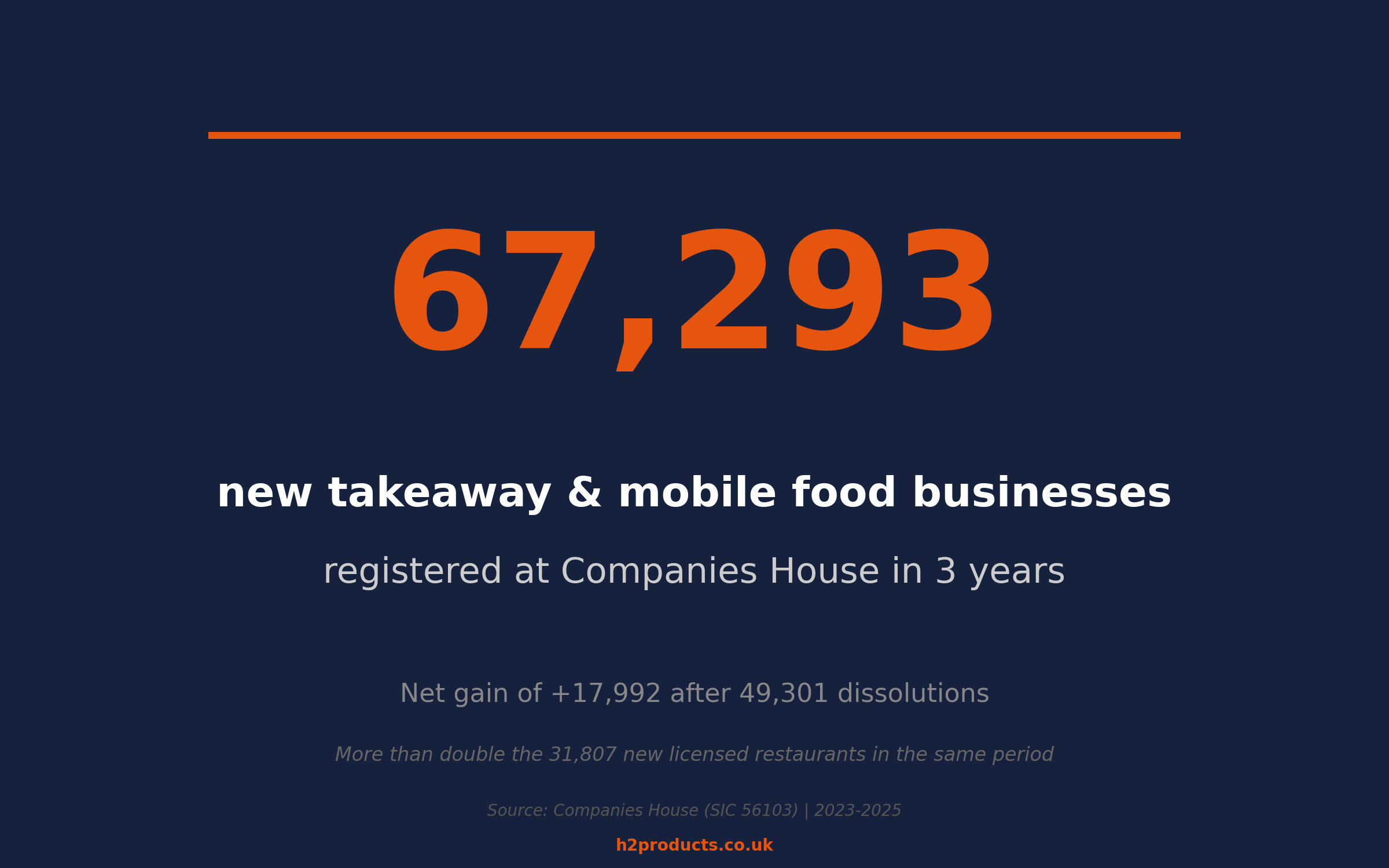
67,293 new takeaway businesses registered in 3 years. That works out at an average of 61 new takeaway companies every single day.
Takeaways: The Volume Leader Across All Hospitality
When you line up the four main food service categories tracked by Companies House, takeaways come out on top on every measure: total new registrations, net growth, and consistency.
| Sub-Sector | 3-Year New Registrations | 3-Year Dissolutions | Net Growth | Ratio |
| Takeaways & Mobile Food | 67,293 | 49,301 | +17,992 | 1.37x |
| Unlicensed Restaurants & Cafés | 33,197 | 21,464 | +11,733 | 1.55x |
| Licensed Restaurants | 31,807 | 24,235 | +7,572 | 1.31x |
| Public Houses & Bars | 21,770 | 17,083 | +4,687 | 1.27x |
A couple of things jump out straight away:
- Takeaways generate more than double the number of new registrations compared to licensed restaurants
- Yes, takeaways also have the highest number of dissolutions (49,301), but they still maintain a 1.37x replacement ratio. Put simply, for every takeaway that closes, 1.37 new ones open
- Cafés (unlicensed restaurants) actually have the strongest ratio at 1.55x, which suggests they tend to stick around the longest
- Pubs sit at the bottom with a 1.27x ratio, which tallies with everything we already know about the challenges facing that part of the market
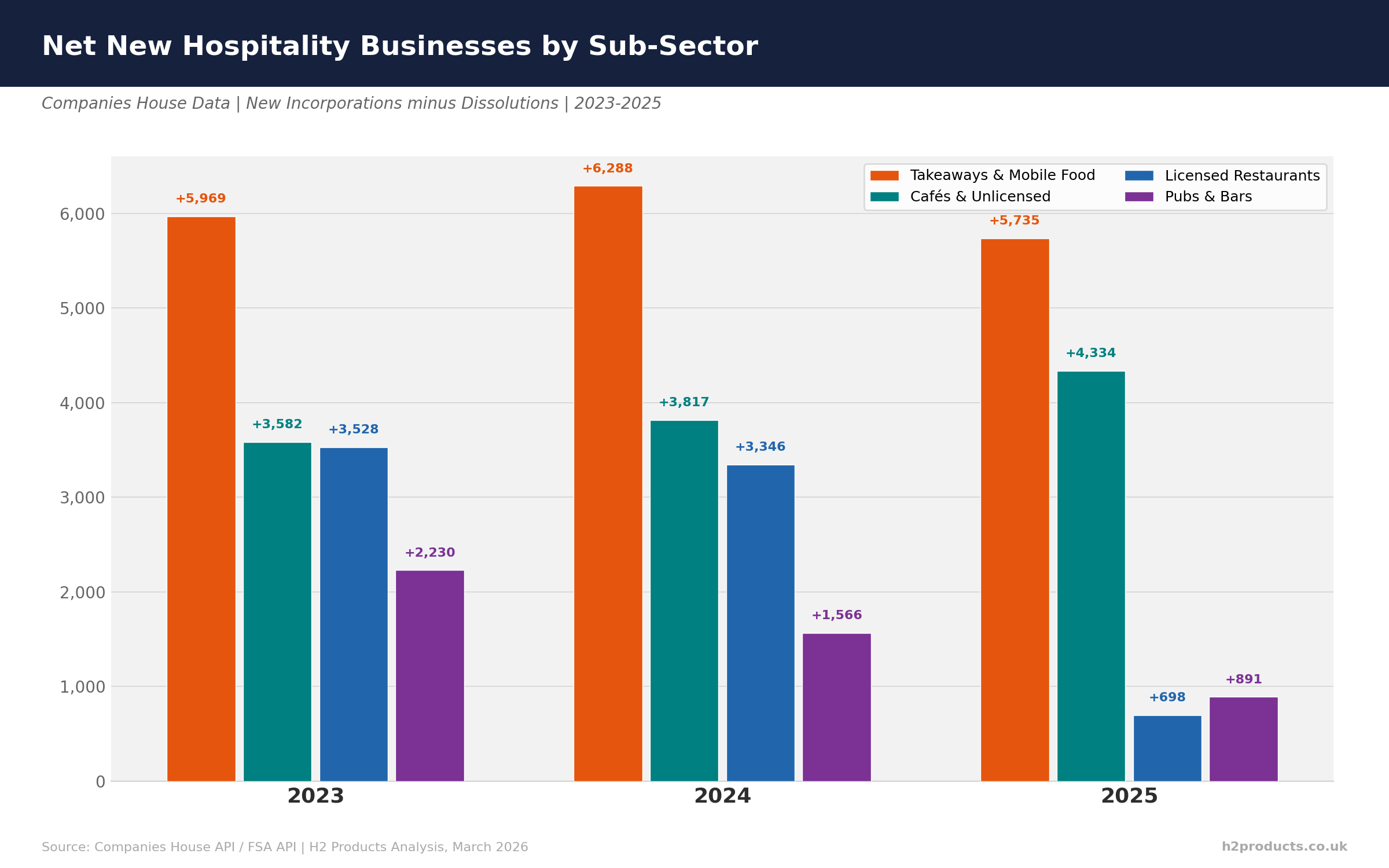
THE KEY INSIGHT: Takeaways are not just the most popular new business type. They represent the largest wave of new commercial kitchen operators entering the UK market. Every one of those 67,293 new businesses needs equipment.
The Seasonal Rhythm: When Takeaways Open and Close
Looking at the monthly figures, there is a clear seasonal pattern in takeaway registrations:
- March is consistently the strongest month for new registrations, with 2,289 new businesses in March 2025 alone (the highest single month in the dataset)
- January also sees a big spike, as people who spent Christmas planning their new venture finally get it registered
- December and January are the only months where closures sometimes outnumber new openings, driven by the post-Christmas cash flow squeeze
- The summer months from June to September stay strong for new registrations as operators get ready for festival season and outdoor eating
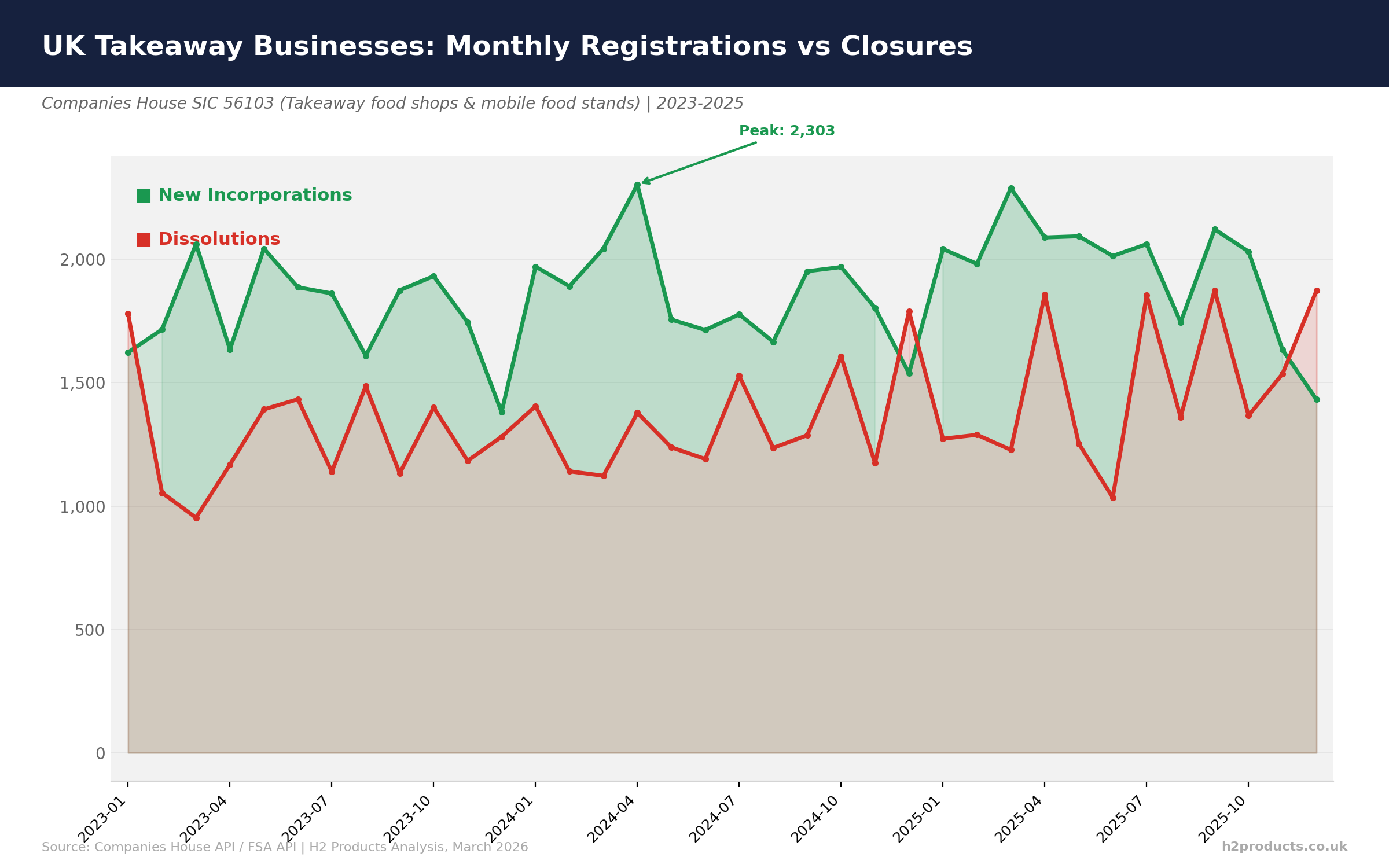
For equipment suppliers, the message is straightforward: the Q1 planning season from January to March is when the biggest wave of new takeaway operators hits the market and starts looking to kit out their kitchens.
Where Are Britain’s New Takeaways? The FSA Heat Map
We also looked at Food Standards Agency (FSA) establishment records to get a second, independent picture of the UK takeaway market and where these businesses are concentrated.
As of March 2026, the FSA lists 63,047 active takeaway and sandwich shop establishments across the UK. To put that in context:
- 138,916 restaurants, cafés and canteens
- 50,783 pubs, bars and nightclubs
The Top 15 local authority areas for registered takeaway establishments are:
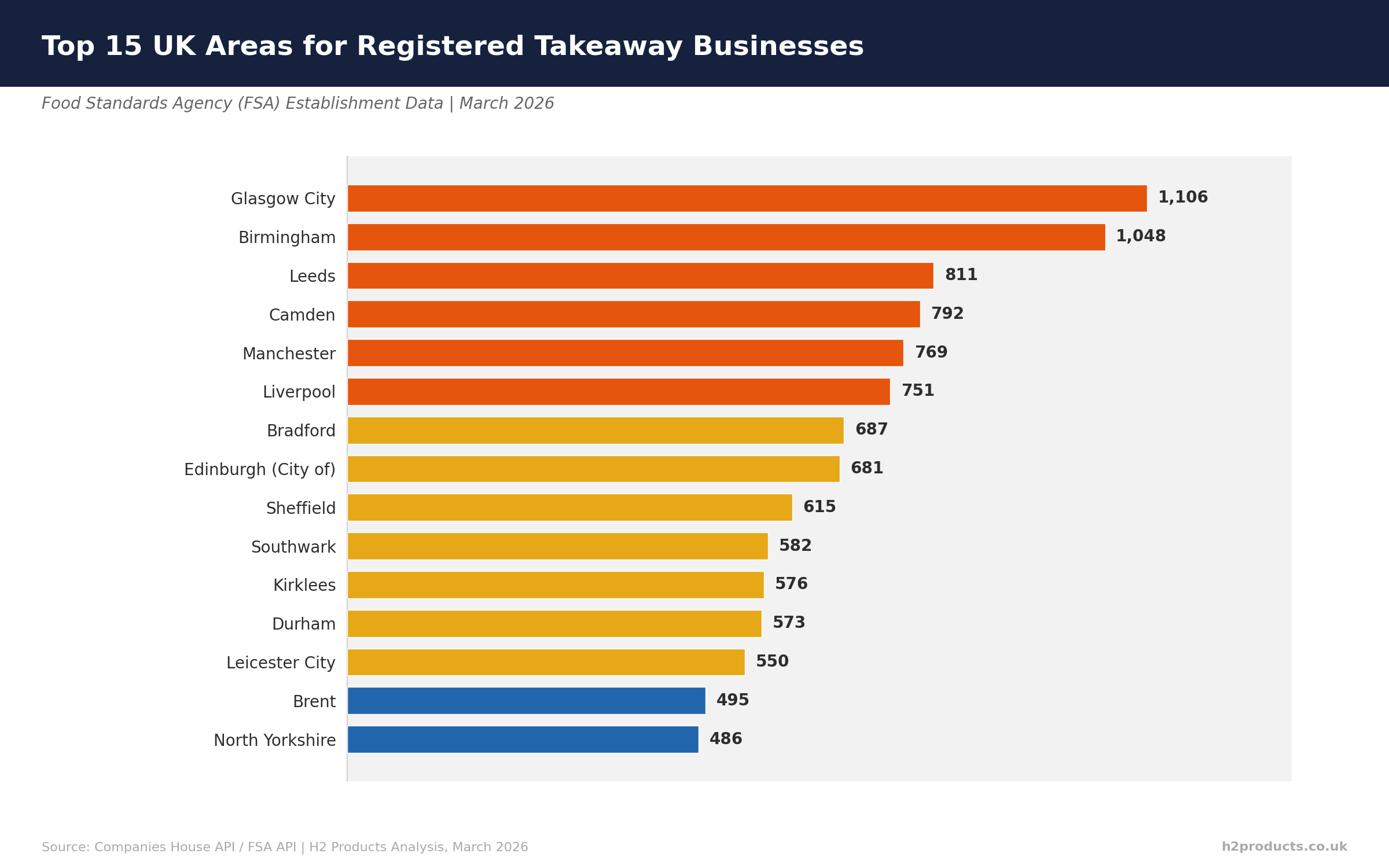
| Rank | Local Authority | Takeaway Establishments |
| 1 | Glasgow City | 1,106 |
| 2 | Birmingham | 1,048 |
| 3 | Leeds | 811 |
| 4 | Camden (London) | 792 |
| 5 | Manchester | 769 |
| 6 | Liverpool | 751 |
| 7 | Bradford | 687 |
| 8 | Edinburgh | 681 |
| 9 | Sheffield | 615 |
| 10 | Southwark (London) | 582 |
| 11 | Kirklees | 576 |
| 12 | Durham | 573 |
| 13 | Leicester | 550 |
| 14 | Brent (London) | 495 |
| 15 | North Yorkshire | 486 |
A few things worth pointing out:
- Scotland punches well above its weight. Glasgow leads the entire UK for takeaway density, and Edinburgh is also in the top 10
- Northern and Midlands cities dominate the list: Leeds, Bradford, Sheffield, Kirklees (Huddersfield), Durham, and Leicester all feature in the top 15
- London boroughs appear individually (Camden, Southwark, Brent), but as stand-alone authority areas they rank lower than the big northern and Scottish cities
- Bradford and Kirklees, both in West Yorkshire, together account for 1,263 takeaway businesses, making the region one of the densest takeaway markets in the country
REGIONAL PRESS ANGLE: Glasgow is the takeaway capital of the UK. Scotland has more registered takeaways per head of population than any English region outside London. Far from being a struggling sector, the takeaway trade is the engine room of Scottish food entrepreneurship.
Food Hygiene: The Takeaway Sector’s Improving Standards
Whenever people talk about the rapid growth in takeaway businesses, the question of standards always comes up. Are they keeping pace? The FSA data gives us a pretty clear answer: the vast majority of takeaways are maintaining good hygiene standards.
| Hygiene Rating | Establishments | % of Total |
| 5 (Very Good) | 31,771 | 50.4% |
| 4 (Good) | 10,462 | 16.6% |
| 3 (Generally Satisfactory) | 7,011 | 11.1% |
| 2 (Improvement Necessary) | 1,553 | 2.5% |
| 1 (Major Improvement Necessary) | 1,246 | 2.0% |
| 0 (Urgent Improvement Necessary) | 174 | 0.3% |
| Awaiting Inspection | 5,342 | 8.5% |
| Other (Pass/Exempt) | 5,488 | 8.7% |
The headline figures:
- Over two-thirds (67.0%) of takeaways hold a rating of 4 or 5, meaning “Good” or “Very Good”
- Only 2.3% have a rating of 0 or 1, which indicates serious food safety problems
- 5% are still awaiting their first inspection. These are most likely recent registrations that the local authority hasn’t got round to visiting yet, which ties in with the strong registration numbers we are seeing
That proportion of businesses awaiting inspection lines up with what the Companies House data is telling us. These are genuinely new businesses that have done the right thing by registering with the FSA and are simply waiting for their first assessment.
Why Takeaways? The Economics Behind the Explosion
So the data is clear: takeaways are where the growth is. But what is actually driving it? There are a few big structural reasons.
- Lower Barriers to Entry
Opening a takeaway costs a fraction of what you would spend on a full-service restaurant. There is no dining room to fit out, no front-of-house team to hire, no tableware to buy. The core investment is a compact commercial kitchen: fryers, prep surfaces, and cold storage. That makes it the most accessible way into the food business.
- The Delivery Platform Effect
Deliveroo, Uber Eats, and Just Eat have completely rewritten the economics of selling food. A takeaway no longer needs a prime high street unit or passing foot traffic. All it needs is a commercial kitchen and a listing on a delivery app. That has opened up cheap industrial units, shared kitchens, and side-street locations as perfectly viable business addresses.
- The Dark Kitchen Revolution
The growth of “dark kitchens” (sometimes called ghost kitchens or cloud kitchens), which are commercial cooking spaces with no customer-facing shopfront, has pushed costs down even further. Google Trends data shows rising search interest for “dark kitchen” and “ghost kitchen” over the past year. These operators register under the same SIC 56103 code, so they are part of the takeaway numbers in the Companies House data.
- The Side-Hustle Generation
Plenty of the new takeaway registrations come from people running food businesses alongside other work: street food traders at weekend markets, home-based caterers who have gone commercial, festival food vendors registering as limited companies. The Companies House data captures all of these under SIC 56103.
- Cost-Conscious Operators
The current economic climate means many new food entrepreneurs are watching every penny from the start. Our wider Google Trends analysis shows that searches for “cheap catering equipment”, “second hand catering equipment”, and “B-Grade catering equipment” are all on the rise. New operators are actively hunting for ways to get quality kit without paying full retail prices.
What Equipment Do You Need to Open a Takeaway?
Every single one of those 67,293 new takeaway businesses needs a basic set of equipment to get going. A typical takeaway kitchen requires:
| Equipment | Purpose | Why It’s Essential |
| Commercial Fryer | Deep-frying: chips, fried chicken, etc. | The single most common piece of takeaway equipment |
| Commercial Oven or Combi Oven | Baking, roasting, reheating | Essential for menu variety |
| Prep Counter Fridge | Cold prep and ingredient storage | Space-efficient, combining workspace and refrigeration |
| Commercial Fridge/Freezer | Bulk ingredient storage | Every commercial kitchen needs cold storage |
| Bain Marie / Hot Holding | Keeping prepared food at safe serving temperature | Essential for counter service and delivery handoff |
| Stainless Steel Prep Tables | Food preparation surfaces | A hygiene compliance requirement |
| Commercial Sink | Handwashing and equipment cleaning | A legal requirement for all commercial kitchens |
| Extraction/Ventilation | Removing heat, steam, and cooking odours | Required under building regulations and HSE rules |
How Much Does It Cost to Set Up a Takeaway Kitchen?
At full retail prices, fitting out even a small takeaway kitchen costs somewhere between £15,000 and £35,000. That covers the core cooking, refrigeration, and prep equipment but does not include things like premises costs, licensing fees, initial stock, or marketing. For startup operators already watching their budgets, that is a serious chunk of money, and it goes a long way to explaining why searches for affordable equipment alternatives are at record levels.
The lower end of that range typically covers a basic setup: a single commercial fryer (£400 to £1,200), an oven or combi oven (£1,500 to £5,000), prep counter fridge (£600 to £1,500), commercial fridge and freezer (£800 to £2,000), and essential prep tables and sinks. At B-Grade prices, you can bring that total down by 30 to 50%, which for a £25,000 fit-out could mean saving £7,500 to £12,500 without compromising on the equipment itself.
What Is B-Grade Catering Equipment?
B-Grade equipment is brand-new, comes with full manufacturer warranties, and meets all current hygiene and safety standards. The only difference between a B-Grade item and a full-price item is cosmetic: a scratch on a side panel, a dent in the transit packaging, or a box that has been opened and resealed. None of these things affect how the equipment performs.
At H2 Products, B-Grade pricing typically brings the cost down by 30 to 50% compared to full retail. For the 61 new takeaway businesses registering every day, that makes B-Grade the smartest way to kit out a commercial kitchen without cutting corners on quality or compliance.
You can browse the full B-Grade range at h2products.co.uk/product-category/b-grade-catering-equipment, or view new equipment at h2products.co.uk/product-category/brand-new.
The Bottom Line: The Takeaway Sector is the Engine of Hospitality Growth
The media focuses on pub closures and restaurant failures, and those problems are very real. But the UK’s takeaway sector is going through something quite different. The numbers from Companies House and the FSA are hard to argue with:
- Volume: 67,293 new takeaway businesses registered in three years, or 61 per day
- Scale: Takeaways produce more than double the new company registrations of licensed restaurants
- Net growth: +17,992 net new businesses after accounting for all closures
- Geography: Glasgow leads the UK for takeaway numbers, with Scottish cities well represented across the top 15
- Quality: 4% of takeaways hold the highest possible hygiene rating
The takeaway is not a secondary food business anymore. It has become the main route into UK food entrepreneurship, driven by lower startup costs, delivery platform reach, and operators who are commercially sharp enough to find quality equipment at the right price.
Frequently Asked Questions
How many takeaway businesses are there in the UK?
As of March 2026, the Food Standards Agency registers 63,047 active takeaway and sandwich shop establishments across the UK. In addition, Companies House records show that 67,293 new takeaway companies (SIC 56103) were registered between January 2023 and December 2025. These are not the same number: the FSA figure is a live snapshot of currently active establishments, while the Companies House figure covers all new registrations over a three-year period.
What equipment do I need to start a takeaway business?
The core equipment for a takeaway kitchen includes a commercial fryer, a commercial oven or combi oven, a prep counter fridge, a commercial fridge and freezer, a bain marie or hot holding unit, stainless steel prep tables, a commercial sink, and extraction or ventilation. The exact specification depends on your menu, but these eight items cover the essential requirements for food safety compliance and efficient service.
How much does it cost to set up a takeaway kitchen?
Equipment costs for a basic takeaway kitchen typically fall between £15,000 and £35,000 at full retail prices. This covers cooking, refrigeration, and preparation equipment but does not include premises, licensing, or stock. B-Grade equipment can reduce that total by 30 to 50%.
Which UK city has the most takeaways?
Glasgow City leads the UK with 1,106 registered takeaway establishments according to FSA data. Birmingham is second with 1,048, followed by Leeds (811), Camden in London (792), and Manchester (769).
What food hygiene rating do most takeaways have?
Over two-thirds (67.0%) of UK takeaways hold a food hygiene rating of 4 or 5 (“Good” or “Very Good”). Half of all takeaways (50.4%) hold the highest rating of 5. Only 2.3% have a rating of 0 or 1.
What is a dark kitchen or ghost kitchen?
A dark kitchen (also called a ghost kitchen or cloud kitchen) is a commercial cooking space that prepares food exclusively for delivery, with no customer-facing shopfront or dining area. These businesses register under the same SIC 56103 code as traditional takeaways at Companies House. The model has grown rapidly because of lower overheads: no front-of-house staff, no high street rent, and no dining furniture.
What is B-Grade catering equipment and is it safe to use?
B-Grade catering equipment is brand-new, unused equipment that has minor cosmetic imperfections or damaged packaging. It comes with full manufacturer warranties and meets all current UK food hygiene and safety standards. The equipment performs identically to full-price stock. B-Grade pricing typically offers savings of 30 to 50% off the retail price.
Is opening a takeaway a good business idea in 2026?
The data suggests strong demand. Over the past three years, 67,293 new takeaway businesses were registered at Companies House, with a net gain of +17,992 after accounting for all closures. The takeaway sector has a 1.37x replacement ratio, meaning 1.37 new businesses open for every one that closes. The UK takeaway market is worth over £31 billion and growing. Lower startup costs, access to delivery platforms like Deliveroo and Just Eat, and the rise of dark kitchens all contribute to making it one of the most accessible routes into food entrepreneurship.
Data Sources and Methodology
| Source | Data Used | Access |
| Companies House API | Advanced Search API: incorporations and dissolutions for SIC codes 56101, 56102, 56103, 56302 (Jan 2023 to Dec 2025) | Free API (API key required) |
| Food Standards Agency API | Establishments endpoint: business type filtering for takeaways (7844), restaurants (1), pubs (7843) | Free public API |
| Google Trends | Supporting keyword analysis from H2 Products’ wider 133-keyword study | Via Google Trends explore |
All data was collected and analysed in March 2026. Companies House data covers complete calendar years 2023 and 2024. The 2025 data runs to December 2025. FSA establishment data is a live snapshot as of March 2026.


